Executive summary
Combining all Baldrige systems with jazz-style practices produces an operating model that is both robust and adaptive. Baldrige supplies governance, continuity, and measurement that protect value; jazz supplies the human skills—listening, improvisation, interplay—that convert those systems into continuous innovation and rapid recovery. Organizations that intentionally align systems and behaviors gain faster learning cycles, higher engagement, and greater resilience while maintaining operational reliability.
Interrelationship
The Baldrige systems are the organization’s architecture: formal roles, processes, metrics, guardrails, and continuity plans that make performance predictable and auditable. The jazz structure is the human operating system: inspiration, listening, improvisation, interplay, and shared rhythm that enable rapid adaptation and creative problem solving. Together: Baldrige defines where the organization must perform and how success is measured; jazz models how people coordinate, adapt, and innovate inside those boundaries. The result is reliable creativity—the ability to deliver consistent outcomes while responding to novel conditions in real time.
Functional mapping of every Baldrige system to jazz behavior
| Baldrige System | Jazz Element | Practical Effect |
|---|---|---|
| Leadership System | Bandleader / Inspire | Sets purpose, tone, psychological safety |
| Governance System | Direction & Form | Clarifies decision rights and safe boundaries |
| Communication System | Call-and-response | Fast, low-friction coordination and cues |
| Strategy System | Motif + Structure | Shared plan with room for solos and pivots |
| Customer Relationship System | Audience Connection | Real-time external feedback shaping priorities |
| Measurement, Analysis & Knowledge | Measure & Refine | Data-driven iteration and validated learning |
| Employee Development & Engagement | Practice & Mastery | Skill depth that enables confident improvisation |
| Operational Excellence System | Shared Rhythm | Reliable timing that supports creative variance |
| Health & Safety System | Steady Groove | Risk controls that protect people and experiments |
| Environmental Management | Context Awareness | Sensitivity to external constraints and cues |
| Community Support System | Social Call-and-Response | Reputation and reciprocal feedback loops |
| Emergency Preparedness System | Rehearsed Cues | Rapid, practiced responses under stress |
| Data Integrity & Security | Trusted Scorekeeping | Accurate signals for decisions and improvisation |
| Resilience System | Adaptive Soloing | Recovering and pivoting under disruption |
| High Reliability Organization | Tight Ensemble | Error-resistant coordination under pressure |
| Transformation System | Theme Development | Scaling successful riffs into new forms |
| Continuity of Operations | Bassline Foundation | Sustains core functions during change |
| Performance Improvement | Iterative Jamming | Continuous small experiments and refinements |
| Culture | Shared Groove & Values | Norms that enable listening, trust, and risk-taking |
Resilience and Reliability addressed together
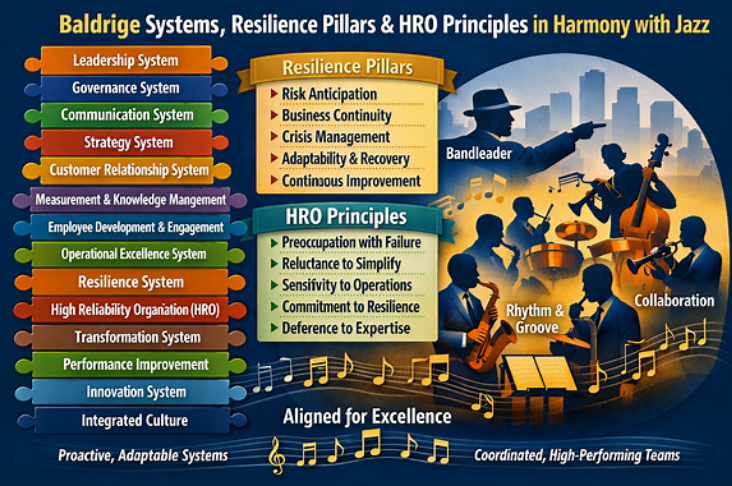
- Reliability is the baseline. Systems like Operational Excellence, High Reliability Organization, Continuity of Operations, Health & Safety, and Data Integrity create the stable foundation (the bassline and drummer) that prevents catastrophic failure.
- Resilience is adaptive capacity. Resilience, Transformation, Emergency Preparedness, and Performance Improvement are the adaptive solos—practices that detect disruption, reconfigure resources, and restore or improve capability.
- How they interact: Reliability reduces the noise and risk so improvisation can be effective; resilience uses improvisation within guardrails to recover and evolve. Reliable systems make improvisation safer; resilient practices make reliability sustainable under stress.
- Operational implication: Design redundancy and clear rollback plans (reliability) while funding rapid experiments and cross-training (resilience). Measure both uptime/error rates and recovery time/learning velocity.
What we learn
- Dual design principle: Build both strong foundations (process, controls, continuity) and practiced adaptive behaviors (listening, improvisation, rapid learning).
- Practice converts freedom into quality: Regular rehearsals, scenario drills, and cross-functional “jam sessions” turn improvisation into dependable adaptive action.
- Feedback is the engine: Short, visible measurement loops (customer signals, operational telemetry, after-action reviews) convert improvisation into validated improvements.
- Culture is the multiplier: Trust, psychological safety, and shared language amplify the effectiveness of both systems and behaviors.
Recommended next steps and metrics
Priority actions
- Codify guardrails — define decision rights, risk thresholds, and rollback rules so teams know safe boundaries for improvisation.
- Create structured jam sessions — time-boxed experiments with hypotheses, metrics, owners, and rollback plans.
- Run ensemble training — cross-functional rehearsals, scenario drills, and listening exercises to build coordination under stress.
- Embed rapid feedback loops — route customer and operational signals into daily rituals and decision gates.
- Measure learning velocity — track experiments run, validated learnings, time to pivot, and employee confidence alongside outcome KPIs.
Suggested metrics
- Reliability: uptime, meantime between failures, operational error rate.
- Resilience: mean time to recover, number of successful recoveries, time from incident to validated improvement.
- Innovation velocity: experiments per quarter, validated learnings per month, time from insight to deployment.
- People: training hours in ensemble skills, cross-functional rehearsal frequency, employee psychological safety score.
Interrelationship of Baldrige Systems and Jazz Structure
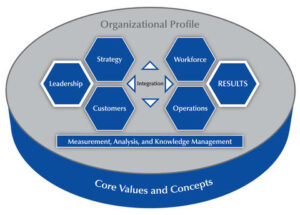
The Baldrige systems describe what an organization must design and manage (leadership, strategy, operations, measurement, workforce, customers, culture, resilience). The Jazz structure describes how high-performing groups behave (inspiration, improvisation, interplay, integration, innovation). Mapped together, Baldrige supplies the form and governance; jazz supplies the behavioral logic that turns form into adaptive performance. The result: a system that is reliable enough to deliver and flexible enough to innovate.
Direct mapping (concise table)
| Baldrige System | Jazz Element | Why they connect |
|---|---|---|
| Leadership | Inspiration (vision/theme) | Sets the tune, tempo, and purpose for everyone. |
| Strategy | Improvisation (melody/solos) | Strategy is the chart; improvisation is adaptive execution within boundaries. |
| Customers | Interplay (call-and-response) | Audience feedback shapes phrasing, priority, and energy. |
| Workforce | Interplay (harmony & collaboration) | Musicianship, rehearsal, trust enable coordinated performance. |
| Operations | Integration (rhythm & coordination) | Rhythm section: processes and cadence that enable safe creativity. |
| Measurement & Analysis | Harmony (chords/sheet music) | Data provides cues and corrective signals to stay in tune. |
| Learning & Improvement | Innovation (new riffs, arrangements) | Practice + experiments produce new capabilities and repertoire. |
| Culture | Venue vibe (stage environment) | Norms and incentives determine whether people will take disciplined risks. |
Resilience pillars — what they are and how they map to jazz
- Organizational Resilience — Design & Redundancy What: Robust structures, cross-training, alternate supply/decision paths. Jazz parallel: Multiple musicians able to cover a part; alternate arrangements when a soloist drops out.
- Operational Resilience — Continuity & Reliability What: Tested continuity plans, HRO practices, fail-safe processes. Jazz parallel: A steady rhythm section (bass/drums) that keeps the band playing through tempo or key changes.
- Individual Resilience — People & Capability What: Training, psychological safety, stress support, recovery practices. Jazz parallel: Musicians’ stamina, practice, and emotional composure during long sets or surprises.
- Learning Resilience — Adaptive Learning What: After-action reviews, knowledge capture, rapid scaling of lessons. Jazz parallel: Turning a successful improvisation into a new arrangement the band can repeat.
Leader implication: Invest first in the rhythm section (operational and organizational resilience) so improvisation and innovation can occur without risking core delivery.
High Reliability Organization (HRO) principles and jazz analogies
- Preoccupation with Failure
- HRO: Treat small anomalies as signals; investigate near misses.
- Jazz: Constant tuning and attention to off-notes; small timing slips are corrected immediately.
- Reluctance to Simplify Interpretations
- HRO: Preserve nuance; seek multiple explanations.
- Jazz: Value complex harmonies and context rather than forcing a single simple explanation for a bad take.
- Sensitivity to Operations
- HRO: Leaders stay connected to front-line realities; real-time situational awareness.
- Jazz: Bandleader listens to the room and adjusts tempo or dynamics on the fly.
- Commitment to Resilience
- HRO: Build detection, containment, and recovery capabilities.
- Jazz: Rhythm section maintains the beat through changes so solos can continue.
- Deference to Expertise
- HRO: In critical moments, authority shifts to the person with the most relevant knowledge.
- Jazz: Let the soloist or section leader lead when their domain matters most.
Practical tie-in: HRO principles are the operational discipline that lets improvisation be safe and effective.
What leaders should learn and do (practical actions)
- Own alignment as a KPI. Ensure strategy, metrics, resource allocation, and culture point the same way.
- Set the tempo and boundaries. Articulate vision (inspiration) and clear guardrails for local improvisation.
- Invest in the rhythm section. Prioritize continuity, HRO practices, and redundancy before scaling experiments.
- Build listening systems. Make customer, front-line, and operational signals visible and actionable at the leadership table.
- Codify safe improvisation. Define experiment budgets, decision rules, and rapid learning protocols.
- Rehearse for disruption. Run scenario practices that combine continuity, safety, and innovation.
- Measure what guides behavior. Use metrics as real-time cues (when to accelerate, stabilize, or pivot), not just postmortems.
- Shape the stage (culture). Reward collaboration, candor, and disciplined risk-taking so people will surface problems and share riffs that work.
Baldrige gives you the disciplined architecture; jazz gives you the adaptive behaviors — align both, invest in resilience and HRO discipline, and you get an organization that reliably delivers today while inventing tomorrow.