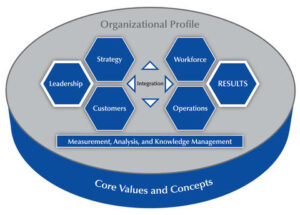

“Baldrige: The Rhythm of Excellence” refers to the concept that the Malcolm Baldrige Performance Excellence Framework is not a one-time project or a static checklist, but rather an ongoing, habitual process that creates a consistent “pulse” or tempo of continuous improvement within an organization.
It represents the integration of core values—such as systems perspective, visionary leadership, and data-driven decision-making—into the everyday operations and management “rhythm” of an organizational sustainable excellence.
Just as Baldrige integrates leadership, strategy, and results, a jazz band integrates the rhythm section, the melody, and the solo into a cohesive “groove.” Jazz is a complex adaptive system where structure and improvisation coexist.
Melody, Harmony, and Rhythm are the essential elements of a high-performance organization.
- Melody: Why are we doing this? (Purpose/Vision/Mission/Goal)
- Harmony: Who is doing it, and how do we work together? (Strategy/Collaboration)
- Rhythm: How do we keep the pace and measure success? (Operations/Execution)
When these three elements are in sync, the organization operates as a cohesive, high-performing “orchestra”.
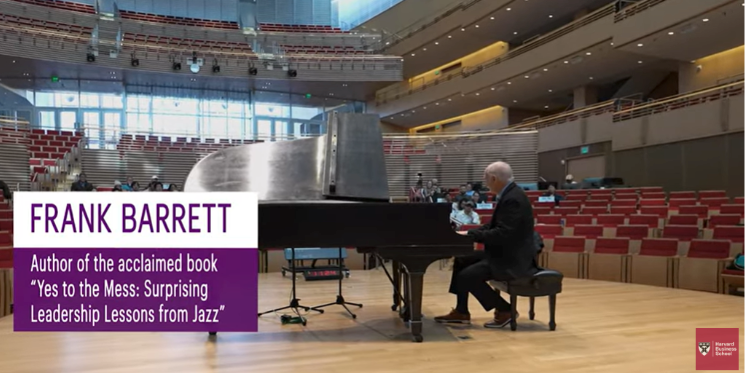
Video: What Managers Can Learn from Jazz Improvisation (3:38)
As part of the Harvard Business School elective course Managing Human Capital, Edward W. Conard Associate Professor Ethan Bernstein is joined by jazz musician Frank Barrett (author of Yes to the Mess: Surprising Leadership Lessons from Jazz and a professor at Case Western Reserve’s Weatherhead School of Management) to illuminate a new way of thinking about organizational structure: How jazz improvisation and the “provocative competence” it elicits serves as a model for the type of collaboration needed for companies to succeed.
Baldrige-aligned organizational function and the jazz ensemble:
- Bandleader → Leadership & Governance Sets direction, tempo, and tone.
- Saxophonist → Resilience & Innovation Improvises, adapts, and brings creative energy.
- Bassist → Operational & Continuity Provides structure and stability.
- Drummer → Reliability & Preparedness Maintains rhythm, consistency, and readiness.
- Pianists → Cross-Functional Support (Comping vs. Management) In jazz, the pianist’s job is to make the soloist sound brilliant by leaving space and adapting to their style. In business operations, this equates to a supportive middle management or cross-functional team. Operations departments act as the “comper” building the structural frameworks (HR, IT, supply chain) that allow customer-facing or product teams (the “soloists”) to execute their work flawlessly.
In a jazz ensemble, the piano player acts as the musical “glue” and the central nervous system of the group, responsible for laying down harmony, keeping the rhythm, and stepping into the spotlight for solos
The band metaphor shows that excellence is a coordinated performance, not a collection of isolated activities.
Deep Dive into relating Jazz into daily life!
Wynton Marsalis at Harvard: At the Speed of Instinct – Choosing Together to Play and Stay Together (2:28:44)
Wynton Marsalis discusses and demonstrates the techniques, concepts, methods, opportunities and objectives that encourage spontaneous, intelligent and cohesive group decision-making in jazz music. Also illuminates how each member of the quintet asserts, accompanies and adjusts to balance the freedom of improvisation with the sacrificial demands of finding and maintaining our common rhythm, known as swing.
One of America’s last true secret societies: The Mardi Gras Indians | 60 Minutes (13:33)
Learn a little Jazz
Collective Improvisation in New Orleans Jazz (5:37)
How to Trade Solos in Jazz, with the Eric Reed Quartet (3:31)
Baldrige Link: Trading solos with allows you to enhance communication
When Big Bands Were Dance Bands (6:16)
Baldrige Link: Interaction between base, drum, and guitar -Agility – keep a strong sense of swing in your rhythm section work, no matter how fast or slow the tempo.
Eli Yamin and Tom Dempsey Discuss Comping on Guitar with a Full Band (4:36)
Baldrige Link: A full rhythm section, enabling you to keep things musical and avoid clutter.
Exploring Improvisation in Jazz (2:59)
Jazz Fundamentals: What Is Swing? (2:47)
Jazz Cat Café: On Air Now: French Quarter New Orleans Jazz / Focus Music for Work & Study | Jazz Meowlody (11:54:56)
Historical New Orleans Jazz – Jazz History, Jazz Funerals, Jazz Festival
Early 1920’s Jazz (5:14)
Benny Goodman Orchestra – Sing, Sing, Sing (Hollywood Hotel) 1937
What Are Jazz Funerals Like? (0:58)
New Orleans Jazz Funeral March (1:39)
New Orleans Jazz Fest 2026 Day 1! All The Highlights! Feat: Music, Second Lines, & and BEST FOOD! (1:05:30)