Executive summary
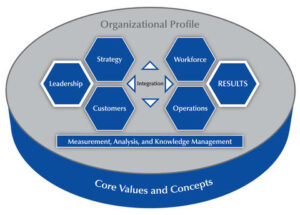
Combining all Baldrige systems with jazz-style practices yields an operating model that is both robust and adaptive. Baldrige supplies the governance, metrics, and continuity that protect value; jazz supplies the human practices—listening, improvisation, interplay—that convert those systems into continuous innovation. Organizations that intentionally align systems and behaviors gain faster learning cycles, higher engagement, and greater resilience while maintaining operational reliability.
Interrelationship overview
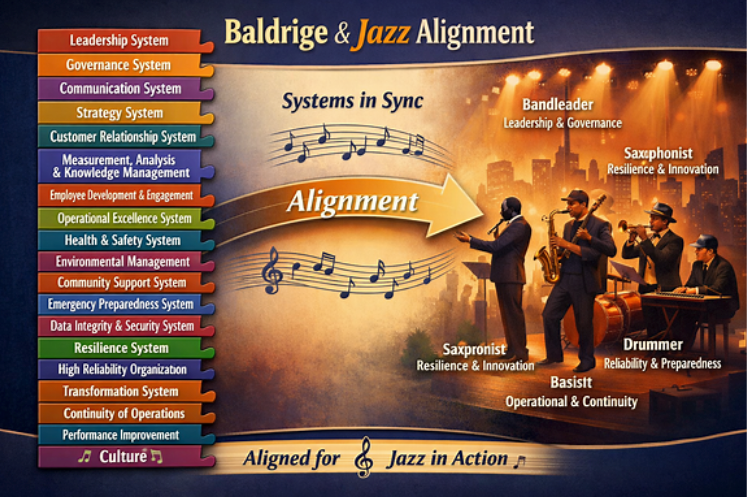
Baldrige systems supply the organizational architecture: roles, processes, metrics, and guardrails that make performance repeatable and auditable. Jazz structure supplies the human dynamics: inspiration, listening, improvisation, and interplay that let people adapt and create in real time. The two are complementary: Baldrige defines where the organization must perform and how success is measured; jazz models how people coordinate, adapt, and innovate inside those boundaries. Together they produce reliable creativity —the ability to deliver consistent results while rapidly responding to novel conditions.
Functional mapping: every Baldrige system → jazz behavior → practical effect
| Baldrige System | Jazz Element | What it Enables |
|---|---|---|
| Leadership System | Bandleader / Inspire | Clear purpose and psychological safety |
| Governance System | Direction & Form | Decision rights and safe boundaries |
| Communication System | Call-and-response | Fast, low-friction coordination |
| Strategy System | Motif + Structure | Shared plan with room for solos |
| Customer Relationship System | Audience Connection | Real-time external feedback shaping choices |
| Measurement, Analysis & Knowledge Management | Measure & Refine | Data-driven iteration and learning |
| Employee Development & Engagement | Practice & Mastery | Skill depth that supports confident improvisation |
| Operational Excellence System | Shared Rhythm | Reliable execution that supports variation |
| Health & Safety System | Steady Groove | Risk controls that protect experimentation |
| Environmental Management | Context Awareness | Sensitivity to external constraints and cues |
| Community Support System | Call-and-Response with Audience | Social license and reciprocal feedback |
| Emergency Preparedness System | Rehearsed Cues | Rapid, practiced responses under stress |
| Data Integrity & Security System | Trusted Scorekeeping | Accurate signals for decisions and improvisation |
| Resilience System | Adaptive Soloing | Recovering and pivoting under disruption |
| High Reliability Organization | Tight Ensemble | Error-resistant coordination under pressure |
| Transformation System | Theme Development | Scaling successful riffs into new forms |
| Continuity of Operations | Bassline / Foundation | Sustains core functions during change |
| Performance Improvement | Iterative Jamming | Continuous small experiments and refinements |
| Culture | Shared Groove & Values | Norms that enable listening, trust, and risk-taking |
What we learn — key insights
- Structure creates safe space for creativity. Clear guardrails reduce the downside of experimentation and let teams improvise without systemic risk.
- Practice converts freedom into quality. Deliberate skill development and rehearsals make improvisation productive rather than chaotic.
- Feedback loops are essential. Short, visible measurement cycles turn improvisation into validated learning.
- Coordination beats command in complexity. Distributed, real-time coordination modeled on musical interplay outperforms rigid top-down control when conditions change quickly.
- Design for dual modes. Explicitly switch between “reliable execution” and “creative exploration” rather than treating them as separate programs.
Recommended next steps (practical, prioritized)
- Run structured jam sessions. Time-boxed experiments with a hypothesis, success metrics, and rollback plan.
- Embed rapid feedback loops. Route customer and operational signals into daily team rituals and decision gates.
- Codify guardrails. Define decision rights, risk thresholds, and escalation paths so teams know safe boundaries.
- Train for ensemble skills. Cross-functional rehearsals, scenario drills, and listening exercises to build coordination.
- Measure learning velocity. Track experiments run, validated learnings, time to pivot, and employee confidence alongside outcome KPIs.
Risks, trade-offs, and suggested metrics
- Risk: Over-control stifles creativity. Mitigation: keep guardrails minimal and review them regularly.
- Risk: Too little structure increases failure and rework. Mitigation: require experiments to include owners and rollback plans.
- Suggested metrics: customer satisfaction delta; experiment success rate; time from insight to deployment; operational error rate; employee engagement in innovation.