Executive Summary
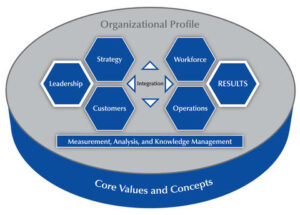
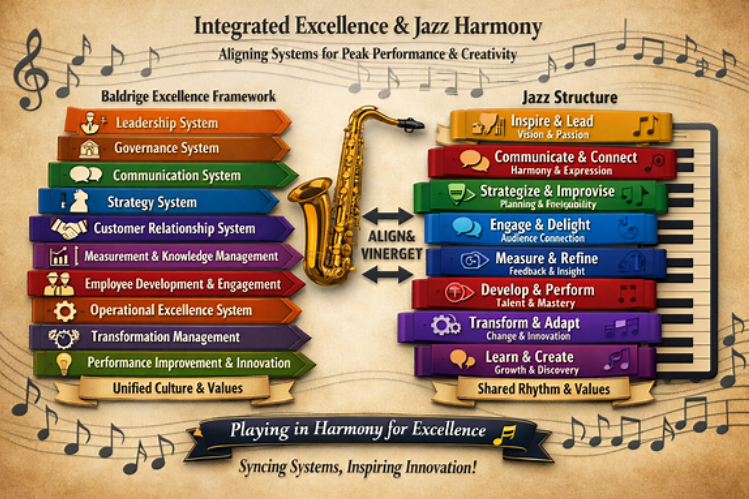
Baldrige categories map to jazz structure as complementary systems: Baldrige supplies the organizational scaffolding (leadership, strategy, operations, measurement, workforce) while jazz supplies the human, improvisational behaviors (inspiration, communication, improvisation, audience engagement). Together they create a disciplined yet adaptive system for sustained innovation and performance.
Explanation of the interrelationship
The Baldrige Excellence Framework defines organizational systems—leadership, strategy, customers, measurement, workforce, operations—that create repeatable, measurable performance and continuous improvement. Jazz structure (vision/inspiration, call-and-response communication, planned forms with improvisation, shared rhythm and values) models how people enact those systems in real time: leaders inspire, teams communicate, performers improvise within agreed forms, and audiences provide feedback. The mapping is not literal but functional: Baldrige gives architecture; jazz gives the behavioral dynamics that animate that architecture.
Quick comparison table
| Baldrige Category | Jazz Element | What it Enables |
|---|---|---|
| Leadership System | Inspire & Lead | Clear vision; motivational direction |
| Strategy System | Strategize & Improvise
Planning & Fungibility |
Plan with adaptive flexibility
Assets or budget allocations are mutually interchangeable |
| Communication System | Communicate & Connect
Harmony & Expression |
Real-time coordination and cues |
| Customer Relationship System | Engage & Delight
Audience Connection |
Tie customer and performance data to immediate team learning cycle |
| Measurement & Knowledge | Measure & Refine
Feedback & Insight |
Feedback loops and iterative learning |
| Workforce Development | Develop & Perform
Talent & Mastery |
Skill growth and mastery |
| Operations System | Shared Rhythm | Reliable execution and timing |
| Transformation Management | Transform & Adapt
Change & Innovation |
Safe space for experimentation |
Executive summary
- Core insight: High performance requires both structure and improvisation. Baldrige supplies the governance, metrics, and processes that reduce risk and scale success; jazz supplies the human practices—trust, listening, rapid adaptation—that turn processes into creative outcomes.
- Practical implication: Embed feedback loops (measurement + audience/customer signals) and safe improvisation zones (pilot projects, empowered teams) so strategy and operations can adapt without losing control.
- Organizational payoff: Combining disciplined systems with practiced improvisation increases resilience, innovation velocity, and employee engagement—the same dynamics that let jazz ensembles innovate while staying coherent.
Recommendations and next steps
- Make improvisation explicit. Create roles, times, and places where teams can experiment (innovation sprints, “jam sessions”) while using Baldrige-style metrics to evaluate outcomes. Bold: designate experiments as low-risk learning investments.
- Strengthen real-time communication. Adopt short, structured rituals (standups, huddles) modeled on musical call-and-response to speed coordination.
- Close the feedback loop. Tie customer and performance data to immediate team learning cycles so measurement drives refinement, not just reporting.
Risks and trade-offs
- Over-structuring kills spontaneity; under-structuring increases chaos. Balance by codifying guardrails (roles, decision rights, metrics) and protecting creative space inside them. Important: measure both outcomes and learning velocity, not only compliance.