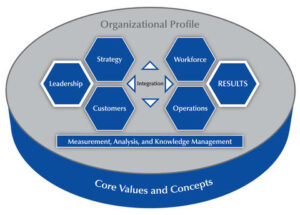
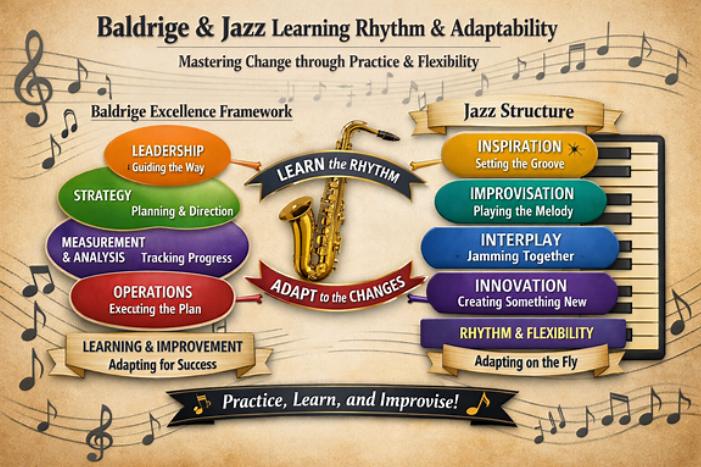
Baldrige Excellence Framework with the structure of jazz, emphasizing how rhythm, learning, and flexibility drive continuous improvement.
Executive summary
- Core thesis: Structure without practiced human dynamics yields compliance; dynamics without structure yields chaos. Combining Baldrige’s systems with jazz-style behaviors produces repeatable excellence that can still pivot creatively.
- Why it matters: Organizations that codify guardrails (roles, metrics, processes) while deliberately training people to listen, improvise, and respond accelerate innovation and improve customer experience.
Baldrige supplies the organizational architecture (leadership, strategy, measurement, workforce, operations); jazz supplies the human dynamics (inspiration, improvisation, interplay) that animate those systems — together they create a disciplined, adaptive engine for sustained innovation and performance.
The Baldrige Excellence Framework defines a comprehensive set of organizational systems and criteria—leadership, strategy, customers, measurement/knowledge, workforce, operations, and results—that guide continuous improvement and resilience. Jazz structure models how people behave inside those systems: leaders set the groove, performers improvise within form, players listen and respond, and audiences (customers) provide immediate feedback. This behavioral layer turns processes into adaptive performance.
Comparison table (key attributes)
| Baldrige Category | Jazz Element | What it Enables |
|---|---|---|
| Leadership / Governance | Inspire & Lead & Setting the Grove | Clear vision and motivational direction |
| Strategy / Planning | Strategize & Improvise &
Playing the Melody |
Long-range plan with adaptive flexibility |
| Measurement & Knowledge | Measure & Refine & Interplay | Rapid feedback loops and learning |
| Workforce Development | Develop & Perform &
Jamming Together |
Skill mastery and collaborative virtuosity |
| Operations / Processes | Innovation & Shared Rhythm & Flexibility & Creating Something New | Reliable execution and timing |
Practical lessons and recommendations
- Create “jam sessions” for innovation. Reserve time/space for cross-functional teams to prototype ideas within defined constraints; treat these as low-risk experiments measured by Baldrige-style metrics. Bold: designate experiments as learning investments.
- Embed fast feedback loops. Connect customer signals and operational metrics to team retrospectives so measurement drives immediate refinement. Bold: shorten the measure→learn→adapt cycle.
- Train for musical skills. Invest in listening, call-and-response communication, and role clarity—these interpersonal skills are the “technique” that enables safe improvisation.
Risks, trade-offs, and guardrails
- Over-structuring kills spontaneity; under-structuring increases operational risk. Balance by codifying decision rights, success metrics, and escalation paths while protecting creative space. Measure both outcomes and learning velocity, not only compliance.