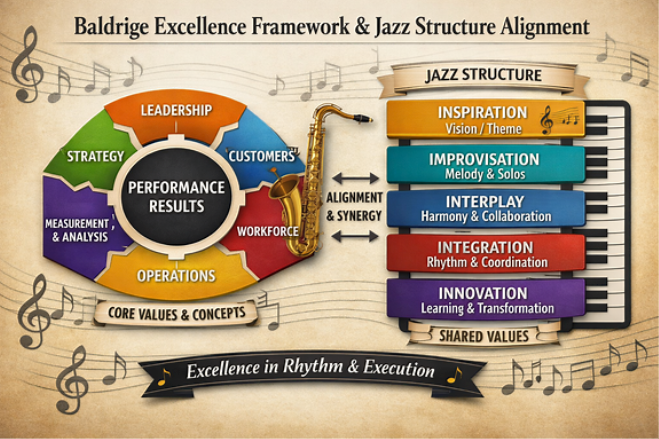
This is a rich visual showing how the Baldrige Excellence Framework aligns with the structure of jazz. It blends organizational systems with musical flow, connecting leadership, strategy, and operations to inspiration, improvisation, and innovation.
Executive summary: CEO and senior leaders
Combine Baldrige systems with jazz practices to achieve both operational reliability and adaptive innovation. For the CEO this means clearer risk-adjusted growth and measurable resilience; for senior leaders it means faster decision cycles and better cross-functional coordination; for the workforce it means higher engagement, clearer expectations, and more autonomy to solve problems. The Baldrige Framework is the proven architecture for performance excellence; aligning it with human practices modeled on jazz accelerates transformation while protecting core operations.
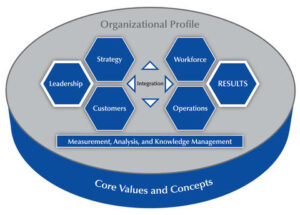
On the left, the six Baldrige categories and results (Leadership, Strategy, Customer Relationships, Measurement & Knowledge, Workforce, Operations,
On the right, structuring a jazz ensemble is the ultimate blueprint for creative teamwork. The bandleader provides direction and unity, the bassist anchors the rhythm, the drummer drives collaboration and pulse, the trumpet explores improvisation, and the saxophone harmonizes and bridges the ensemble’s collective expression.
At the center, a bold arrow labeled “Alignment” and “Strategy” connects the two sides, showing how disciplined systems and creative flow harmonize.
Jazz is the perfect metaphor for organizational excellence. A jazz ensemble succeeds because every musician listens, adapts, and contributes to a shared purpose. Baldrige organizations do the same. They balance structure with improvisation, discipline with creativity, and individual mastery with collective performance. Jazz ensembles succeed through listening, alignment, improvisation, shared rhythm, and disciplined structure.
Baldrige Excellence Framework aligns with the structure of jazz. It blends organizational systems with musical flow, connecting leadership, strategy, and operations to inspiration, improvisation, and innovation.
The Baldrige Excellence Framework maps to more that Jazz music. It maps widely because it captures how people with a shared purpose, design and organize systems to create value, learn, and continually improve. Baldrige provides a framework that addresses shared issues, challenges, and opportunities across any human organization including music, business, dance, medicine, economics, accounting, management, and every other disciplined human endeavor
1. What the Baldrige–Jazz Alignment Shows
Baldrige defines the high-performance systems visionary leaders design and continually improve. Excellence is a System, Not a Silo
Jazz reveals the behaviors required to make those systems perform in real time.
Together they show that excellence is not a checklist — it is a coordinated performance.
Baldrige systems align, organizations become reliable, adaptive, innovative, and high-performing. The Baldrige systems describe what an organization must design and manage (leadership, strategy, operations, measurement, workforce, customers, resilience, reliability, and culture that supports high performance).
The Jazz structure describes how high-performing groups behave (inspiration, improvisation, interplay, integration, innovation). Mapped together, Baldrige supplies form and governance; jazz supplies the behavioral logic that turns form into adaptive performance. The result: a system that is reliable enough to deliver and flexible enough to innovate.
2. How the Systems Interrelate with the Jazz Structure
The Baldrige categories provide the organizational architecture (roles, processes, metrics, continuity) while the Jazz structure supplies the human operating practices (inspiration, listening, improvisation, interplay). Aligning both yields reliable creativity: faster learning, safer experimentation, and stronger resilience—value that is measurable for CEOs, senior leaders, and the workforce.
Functional comparison (select categories mapped to jazz behaviors and stakeholder value)
| Baldrige category | Jazz element | Value to CEO / Senior leaders / Workforce |
|---|---|---|
| Leadership System | Bandleader / Inspire / Vision & Theme | CEO: strategic clarity; Leaders: decision alignment; Workforce: psychological safety. |
| Governance System | Direction & Form | CEO: risk control; Leaders: clear decision rights; Workforce: predictable boundaries. |
| Strategy System | Motif & Improvisation
Melody & Solos |
CEO: adaptive strategy; Leaders: pivot capability; Workforce: empowered discretion. |
| Measurement & Knowledge | Measure & Refine | CEO: evidence for investment; Leaders: course-correction signals; Workforce: actionable feedback. |
| Operational Excellence / Continuity | Shared Rhythm / Bassline
Interplay / Harmony & Collaboration |
CEO: reliable delivery; Leaders: operational predictability; Workforce: consistent workflows. |
| Resilience / Emergency Preparedness | Rehearsed Cues / Adaptive Soloing | CEO: reduced downtime; Leaders: faster recovery; Workforce: practiced response skills. |
| Workforce Development & Culture | Practice & Interplay | CEO: talent retention; Leaders: bench strength; Workforce: mastery and engagement. |
What we learn (synthesized insight)
- Structure enables safe improvisation. Clear guardrails (governance, continuity, data integrity) reduce downside risk so teams can experiment.
- Practice converts freedom into dependable outcomes. Rehearsals, cross-training, and scenario drills make improvisation repeatable and reliable.
- Feedback loops are the engine of improvement. Measurement + rapid reflection turns experiments into validated improvements that scale.
Recommended next steps (practical)
- Pilot “jam sessions”: time-boxed experiments with hypotheses, metrics, owner, rollback plan. Metric: experiments/month; validated learnings.
- Codify guardrails: decision rights, risk thresholds, escalation paths. Metric: incidents avoided; mean time to recover.
- Ensemble training: cross-functional rehearsals and after-action reviews. Metric: recovery time; employee confidence scores.
Risks: over-control stifles creativity; under-control increases failures—mitigate by limiting guardrails to essentials and requiring rollback plans.
Each Baldrige system has a corresponding Jazz behavior that activates it:
- Leadership → Inspiration Leaders set the theme, tone, and tempo.
- Governance → Shared Rhythm & Values Clear rules create safe space for improvisation.
- Communication → Connection & Listening Real-time coordination depends on shared signals.
- Strategy → Improvisation Strategy provides the chart; teams adapt the melody.
- Customer Systems → Interplay Customer feedback shapes the performance.
- Operations → Integration The rhythm section keeps the beat steady.
- Measurement → Harmony Data provides cues that keep the organization in tune.
- Workforce Development → Mastery & Collaboration Skilled, trusted performers make high-quality execution possible.
- Performance Improvement → Innovation Learning cycles create new riffs and new capabilities.
- Culture → The Stage Culture determines whether people take risks, listen, and learn.
Insight: Baldrige systems fail without the human behaviors that jazz models — listening, adapting, coordinating, and innovating.
A high-performing organization behaves like a world-class jazz ensemble:
- Leadership sets the theme
- Strategy provides the chart
- Operations keep the beat
- Measurement keeps everyone in tune
- Workforce mastery drives performance
- Customers shape the energy
- Culture sets the stage
- Resilience keeps the music going
- HRO discipline prevents breakdowns
Bottom line: When Baldrige systems, Jazz behaviors, Resilience pillars, and HRO principles align, the organization becomes coherent, adaptive, reliable, and innovative — all at the same time.
3. Why These Images Matter to a CEO
From the top of the organization, these images communicate three essential truths:
Excellence is a System, Not a Silo
The images show that leadership, strategy, customers, workforce, operations, data, resilience, and culture are interdependent — like instruments in a band. A CEO sees immediately:
“If one system is out of tune, the whole performance suffers.”
Alignment Is the CEO’s Primary Job
The golden arrows, musical notes, and “Systems in Sync” message reinforce that alignment is not accidental. A CEO must ensure:
- Strategy aligns with operations
- Culture aligns with leadership
- Data aligns with decisions
- Workforce aligns with mission
Just like a bandleader ensures the ensemble plays the same song.
Adaptability Is the New Competitive Advantage
Jazz is improvisational — but not chaotic. It’s structured flexibility. That’s exactly what modern organizations need:
- Respond to disruption
- Adjust to customer needs
- Innovate continuously
- Maintain reliability under pressure
The images show that resilience + innovation are not opposites — they are partners.
4. What We Learn About the Baldrige Excellence Framework
Across the images, Baldrige becomes clear as a coherent performance system:
Baldrige is a Leadership System
Leadership sets tone, tempo, and expectations — just like the bandleader.
Baldrige is a Strategy Execution System
Strategy is not a document — it’s a rhythm that must be felt across the organization.
Baldrige is a Learning System
Measurement, analysis, and knowledge management are the “sheet music” that guide performance.
Baldrige is a Workforce Engagement System
People are the musicians — their engagement determines the quality of the performance.
Baldrige is a Culture System
Culture is the stage everything happens on. If the stage is unstable, the performance collapses.
Baldrige is a Resilience & Reliability System
The inclusion of:
- Resilience
- Emergency Preparedness
- High Reliability Organization (HRO)
- Continuity of Operations shows that excellence requires consistency under pressure, not just good days.
5. What We Learn from the Structure of Jazz
Jazz is the perfect metaphor for modern organizational excellence because it teaches:
1. Mastery + Improvisation = High Performance
Jazz musicians practice relentlessly — then improvise confidently. Organizations must do the same:
- Standardize what must be consistent
- Innovate where flexibility is needed
2. Listening Is as Important as Playing
In jazz, musicians constantly listen to each other. In organizations, this translates to:
- Customer listening
- Workforce listening
- Environmental scanning
- Data listening
Listening is a leadership competency.
3. Roles Are Distinct but Interdependent
Each musician has a unique role — but the music only works when roles integrate. Same with Baldrige systems.
4. Alignment Creates Flow
When the rhythm section, melody, and harmony align, the music flows. When leadership, strategy, operations, and culture align, the organization flows.
5. Culture Shapes Performance
Jazz clubs have a vibe — an atmosphere that shapes the music. Organizational culture does the same.
6. The CEO Takeaway
Across all three images, the message to a senior leader is unmistakable:
Excellence is not a checklist — it’s a coordinated performance. Baldrige provides the structure. Jazz provides the mindset. Alignment turns both into results.