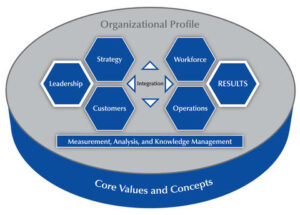

“Baldrige: The Rhythm of Excellence” refers to the concept that the Malcolm Baldrige Performance Excellence Framework is not a one-time project or a static checklist, but rather an ongoing, habitual process that creates a consistent “pulse” or tempo of continuous improvement within an organization.
It represents the integration of core values—such as systems perspective, visionary leadership, and data-driven decision-making—into the everyday operations and management “rhythm” of an organizational sustainable excellence.
In the Baldrige Excellence Framework, the concept of a “Systems Perspective” is paramount managing an organization as a unified whole to sustain excellence. A Jazz Ensemble is the perfect sonic metaphor for this. It is a system where individual mastery (Operations) meets shared structure (Strategy) and real-time adaptation (Agility) to create a unique experience for the listener (Customer).
Who Should Attend:
- Executives & Senior Leaders: Those responsible for organizational design and transformation to sustainable excellence who need to foster “provocative competence”—the ability to stimulate brilliance in others through minimal constraints.
- Agile & Project Managers: Individuals leading cross-functional teams where “distributed leadership” and real-time collaboration are critical for success.
- Innovation & Strategy Leads: Professionals focused on iterative experimentation, “unlearning” old patterns, and building a culture where mistakes are treated as data for innovation.
- Human Resource & Culture Visionary Leaders: Leaders tasked with building sustainable, high-performing environments through high-level listening, psychological safety, and mutual support.
What Will You Learn:
Business leaders can learn to build sustainable, high-performing organizations by adopting a “jazz mindset,” which balances structured discipline with improvisational agility. By treating organizations as jazz ensembles rather than rigid orchestras, leaders can foster a culture of decentralized innovation, deep trust, and continuous, real-time collaboration.
Key lessons from jazz for business leaders include:
- Balance Structure with Autonomy (“Guided Autonomy”)
- Minimal Structure: Jazz musicians don’t operate in chaos; they follow basic chord progressions and rhythms. Similarly, leaders should provide enough structure (clear goals, values) to ensure alignment while allowing employees freedom to determine how to achieve them.
- Empowered Teams: Move from a “conductor” model to a “jazz band” model, where decision-making is decentralized, allowing those closest to the action to experiment and adapt.
- Embrace “Right Mistakes” and Experimentation
- “No Mistakes” Mindset: Miles Davis famously said, “If you’re not making a mistake, it’s a mistake.” Jazz teaches that errors are necessary for innovation.
- “Yes to the Mess”: Instead of fearing failures, leaders should cultivate a culture of “proactive experimentation” where mistakes are treated as learning opportunities and “right mistakes” are leveraged to find new, better solutions.
- Cultivate “Deep Listening” and Radical Collaboration
- “Big Ears”: Duke Ellington noted that a good musician is, above all, a good listener. Leaders must promote active listening—not just hearing, but understanding the context and tacit knowledge of others.
- “Comping” (Supporting Others): Jazz musicians take turns soloing and supporting (“comping”). A high-performing organization encourages staff to “make others sound good,” supporting colleagues to excel rather than focusing on solo heroics.
- Practice Shared Leadership and Trust
- Rotational Leadership: Leadership in jazz is distributed; the person with the best insight or “melody” takes the lead, regardless of rank.
- Psychological Safety: Musicians cannot improvise if they fear judgment. Leaders must create a safe environment where employees feel secure taking risks.
- “Unlearn” and Pivot Fast
- Never Play the Same Thing Twice: Stagnation kills creativity. Leaders must encourage the unlearning of old, comfortable habits to remain relevant.
- Agile Adaptation: Jazz musicians can change direction instantaneously based on the “feel” of the music. Businesses must be similarly nimble, pivoting based on real-time market feedback.
- Lead with “Provocative Competence”
- Leaders should act as “invisible guides,” challenging team members to push beyond their current abilities. This involves placing employees in the “spotlight” (e.g., assigning challenging, new tasks) to stimulate growth and new, creative ideas.
Keynote Speakers: The Rhythm of Excellence
Hear from industry experts and visionaries who have successfully navigated the path to sustainable excellence.
Keynote speakers draw on insights from jazz music, cover how to build agile, collaborative, and innovative organizations that thrive amidst disruption. By treating business as a “jam session,” experts emphasize moving from rigid, top-down command-and-control models to a “jazz mindset” that fosters long-term, sustainable excellence.
Keynote sessions cover the following core pillars:
- Visionary Leadership as “Jazz Improvisation”
- Decentralized Innovation: Empowering teams to take initiative, like musicians taking solos within a collaborative framework, rather than waiting for direction from a single leader.
- “Provocative Competence”: Utilizing minimal structure (basic chord changes) to encourage maximum creativity, allowing employees to experiment within designated guardrails.
- Shared Leadership: Understanding that leadership is fluid—rotating based on expertise rather than hierarchy—where individuals take turns, or “solo,” to meet specific, real-time challenges.
- Innovation via “Intelligent Risk-Taking”: The Baldrige criteria emphasize intelligent risk-taking and agility. Jazz teaches that “if you’re not making a mistake, it’s a mistake”. Leaders can foster a culture where experimentation is celebrated, treating “wrong notes” as opportunities to pivot and create new values.
- Cultivating a High-Performance Culture that Sustains Excellence
- Radical Listening and Collaboration: Fostering a culture where team members deeply listen to each other to make the whole team sound better, rather than focused on individual accolades.
- “Playing it Safe Gets You Tossed Off the Stage”: Encouraging calculated risks and embracing the “danger” of composing in real time to avoid stagnant strategies.
- “Parking Your Ego at the Door”: Prioritizing humility and the shared goal over personal agendas, ensuring that all voices can contribute to the “music”.
- Sustainable Excellence and Resilience
- Improvising Upon “Mistakes”: Viewing errors not as failures, but as opportunities for learning and pivoting to create new, innovative solutions.
- “Yes to the Mess”: Embracing the inherent ambiguity and “messiness” of complex projects as a creative opportunity, rather than trying to overly structure and control them.
- Continuous Practice and Preparation: Recognizing that improvisation requires high technical proficiency, intelligent risk taking and innovation. Sustained excellence requires constant, deliberate practice—”woodshedding”—to adapt to new situations.
- Practical Application in Business
- Building “T-Shaped” Teams: Creating teams with deep expertise cultivating individuals with deep expertise in one area (vertical) and broad, working knowledge across other disciplines (horizontal). This enables team resilience, faster collaboration, reduced bottlenecks, and increased innovation by bridging silos.
- Reimagining Performance Management and Employee Engagement: Shifting from annual reviews to real-time feedback and mentoring that supports “the soloist” (employee) to shine.
- Adaptive Strategy for Excellence: Adapt rigid long-term plans to “preparation,” allowing the organization to transform (change direction) rapidly, similar to a jazz band pivoting in the middle of a live performance.
By implementing these jazz-inspired principles, leaders learn how to create a sustainable, high-performing organization that is creative, innovative, resilient, highly reliable, and capable of handling the volatility of the modern dynamic business environment.
Interactive Workshops:
Participate in hands-on sessions designed to provide practical tools and techniques for immediate implementation to achieve sustainable excellence.
Interactive workshops for leaders identify the interrelationship between jazz music and building a sustainable, high-performing organization by adopting a “jazz mindset”—moving from rigid command-and-control to agile, collaborative improvisation. Key areas covered include shared leadership, deep listening, embracing mistakes as learning opportunities, and finding the right balance between structure and autonomy.
Here is what business leaders learn:
- Embracing a Culture of Improvisation & Agility
- Yes to the Mess: Sustainable excellence leaders learn to accept ambiguity and “say yes” to unexpected challenges, treating problems as opportunities for innovation rather than disasters.
- Proactive Experimentation: Just as jazz musicians try new phrases on the fly, teams learn to “act their way into the future” rather than waiting for a perfect plan.
- The “Right Mistake” Mindset: Workshop participants learn to treat mistakes as “data points” for learning, cultivating a psychological safety zone where experimentation is encouraged.
- Collaborative Visionary Leadership & Teamwork
- Distributed Leadership (Soloing and Supporting): Leaders learn when to step into the spotlight (solo) and when to “comp” (accompany), supporting others to innovate.
- Deep Listening & “Big Ears”: Musicians must listen to others more than themselves. Leaders learn that effective teamwork requires active listening, noticing non-verbal cues, and responding to colleagues in real-time.
- Shared Purpose over Ego: Teams are taught to “serve the music”—meaning they park personal egos and agendas to serve the larger organizational goal.
- Creating a Sustainable Organizational Structure
- Guided Autonomy (Minimum Constraints): Jazz operates within structure (chords) but allows freedom (melodies). Leaders learn to provide “just enough structure” to encourage autonomy while ensuring alignment with company goals.
- The Art of Unlearning: To innovate, leaders must break away from “sacred” routines and patterns that worked in the past but block future creativity.
- Diverse Teams as Catalysts: Just as different musical instruments create harmony, a diverse team of specialists encourages new perspectives and prevents stagnant thinking.
- Interactive Workshop Elements
- Live Band Metaphors: Participants observe a live band and then discuss how the players improvised, supported each other, and navigated mistakes.
- Hands-on Exercises: Leaders might engage in activities like “call and response” communication, word-at-a-time storytelling, or rhythmic tapping to experience real-time collaboration.
This approach transforms leaders from “conductors” who demand perfect adherence to a score into “jazz leaders” who act as conductors, players, and supportive bandmates in a dynamic
Networking Opportunities
Connect with like-minded professionals and award recipients. Build valuable relationships that can propel your organization forward.
Engauge with leaders from high-performing businesses, schools, hospitals, and city governments from across the U.S.
An attendee will learn how business leaders that utilizes jazz music as a metaphor for organizational design—often termed “Leadership Jazz” or “The Jazz Experience”—receives unique, high-value networking opportunities designed to foster collaboration, agility, and sustainable excellence.
Networking opportunities include:
- Interactive “Jazz” Workshops (Team Collaboration): Networking with peers while practicing shared leadership, listening skills, and navigating uncertainty.
- Intimate “After Hours” Conversations: Similar to how jazz musicians socialize after a performance, these conferences offer, or are situated in, intimate settings (e.g., wine bars, lounge settings) that promote deeper, more relaxed conversations compared to standard, high-stress networking events.
- Industry “Impact” Connections: Attendees network with sustainability professionals, industry leaders, and leaders focusing on merging profit and purpose, helping build connections across sectors.
- Peer-to-Peer Experiential Learning: Attendees share experiences about real-world leadership challenges and sustainable practices, encouraging the development of a supportive network with like-minded, mission-driven professionals.
- Executive Networking and Mentorship: These events often bring together senior executives, sustainable excellence experts, and academic faculty, facilitating connections between emerging leaders and industry veterans.
The jazz theme fosters an atmosphere that is “sophisticated yet relaxed,” which is designed to soften the mood and encourage authentic relationships rather than just quick business transactions.
Panel Discussions
Engage in thought-provoking conversations with leaders and innovators who are shaping the future of organizational sustainable excellence.
Learn how to create a culture of continuous learning and improvement resulting in organizations that are innovative, high-performing, reliable, resilient, and sustainable.
What Will You Learn:
Business leaders can learn to build sustainable, high-performing organizations by adopting a “jazz mindset,” which balances structured discipline with improvisational agility. By treating organizations as jazz ensembles rather than rigid orchestras, leaders can foster a culture of decentralized innovation, deep trust, and continuous, real-time collaboration.
Key lessons from jazz for business leaders include:
- Balance Structure with Autonomy (“Guided Autonomy”)
- Minimal Structure: Jazz musicians don’t operate in chaos; they follow basic chord progressions and rhythms. Similarly, leaders should provide enough structure (clear goals, values) to ensure alignment while allowing employees freedom to determine how to achieve them.
- Empowered Teams: Move from a “conductor” model to a “jazz band” model, where decision-making is decentralized, allowing those closest to the action to experiment and adapt.
- Embrace “Right Mistakes” and Experimentation
- “No Mistakes” Mindset: Miles Davis famously said, “If you’re not making a mistake, it’s a mistake.” Jazz teaches that errors are necessary for innovation.
- “Yes to the Mess”: Instead of fearing failures, leaders should cultivate a culture of “proactive experimentation” where mistakes are treated as learning opportunities and “right mistakes” are leveraged to find new, better solutions.
- Cultivate “Deep Listening” and Radical Collaboration
- “Big Ears”: Duke Ellington noted that a good musician is, above all, a good listener. Leaders must promote active listening—not just hearing, but understanding the context and tacit knowledge of others.
- “Comping” (Supporting Others): Jazz musicians take turns soloing and supporting (“comping”). A high-performing organization encourages staff to “make others sound good,” supporting colleagues to excel rather than focusing on solo heroics.
- Practice Shared Leadership and Trust
- Rotational Leadership: Leadership in jazz is distributed; the person with the best insight or “melody” takes the lead, regardless of rank.
- Psychological Safety: Musicians cannot improvise if they fear judgment. Leaders must create a safe environment where employees feel secure taking risks.
- “Unlearn” and Pivot Fast
- Never Play the Same Thing Twice: Stagnation kills creativity. Leaders must encourage the unlearning of old, comfortable habits to remain relevant.
- Agile Adaptation: Jazz musicians can change direction instantaneously based on the “feel” of the music. Businesses must be similarly nimble, pivoting based on real-time market feedback.
- Lead with “Provocative Competence”
- Leaders should act as “invisible guides,” challenging team members to push beyond their current abilities. This involves placing employees in the “spotlight” (e.g., assigning challenging, new tasks) to stimulate growth and new, creative ideas.
Who Should Attend:
- Executives & Senior Leaders: Those responsible for organizational design and transformation to sustainable excellence who need to foster “provocative competence”—the ability to stimulate brilliance in others through minimal constraints.
- Agile & Project Managers: Individuals leading cross-functional teams where “distributed leadership” and real-time collaboration are critical for success.
- Innovation & Strategy Leads: Professionals focused on iterative experimentation, “unlearning” old patterns, and building a culture where mistakes are treated as data for innovation.
- Human Resource & Culture Visionary Leaders: Leaders tasked with building sustainable, high-performing environments through high-level listening, psychological safety, and mutual support.
Key Skills & Disciplines Covered:
By implementing these principles, leaders can create organizations that are not just high performing, but also resilient, adaptive, sustainable, capable of producing “music” that remains fresh and relevant in a chaotic environment.
The Structural Alignment between Baldrige Core Values with Jazz Elements and Alignment & Rationale
| Baldrige
Core Value |
Jazz Element | Alignment & Rationale |
| Systems Perspective | The Arrangement / Polyphony | In jazz, every instrument (drums, bass, piano, horns) functions as an interconnected system. No part stands alone; the bassist listens to the drummer to lock in the groove, just as operations must align with strategy. The “System” is the song form itself. |
| Visionary Leadership | The Bandleader | Leaders like Miles Davis set the “key” and the “tempo” (vision) but trust the musicians to execute. They practice distributed leadership, stepping back to let others solo, intervening only to guide the overall direction or transition. |
| Customer-Focused Excellence | Call and Response / The Audience | Jazz is a dialogue. Musicians constantly read the room’s energy. “Call and response” is the feedback loop—if the audience (customer) reacts to a riff, the band builds on it. The performance is tailored in real-time to the listeners’ vibe. |
| Valuing People | The Solo / Individual Voice | Jazz celebrates the unique “voice” of each player. A band doesn’t want five identical saxophonists; it values the distinct tone and style of each member. The structure is designed to give every person a moment to shine (empowerment). |
| Agility and Resilience | Improvisation / “No Wrong Notes” | The definition of agility. When a “mistake” happens, the band doesn’t stop; they adapt. As Herbie Hancock noted, Miles Davis didn’t judge a wrong chord—he played a melody that made it right. Resilience is the ability to recover the groove instantly. |
| Organizational Learning | The Jam Session / “Shedding” | Musicians “shed” (practice) rigorously to master their craft. Jam sessions are knowledge-sharing hubs where mentors pass down oral traditions and techniques to younger players, ensuring the survival and evolution of the genre. |
| Focus on Success | The Gig / The Setlist | Success is a cohesive performance that gets the band booked again. It requires balancing short-term execution (the current song) with long-term viability (career longevity and reputation). It’s about sustaining the ensemble’s livelihood. |
| Innovation | Fusion / Re-harmonization | Jazz demands novelty. Musicians take a “standard” (an existing process) and re-harmonize it or fuse it with new genres (e.g., Latin Jazz, Fusion). Innovation is not rejecting the past, but building new complexity on top of it. |
| Management by Fact | Music Theory / The Changes | Improvisation isn’t random; it’s based on hard data (theory). You must know the chord progression (the facts) to navigate the song. If you ignore the underlying mathematical structure (tempo, key, changes), the system collapses into noise. |
| Societal Contributions | Cultural Ambassadorship | Jazz has historically been a voice for civil rights and social change. It contributes to society by modeling democracy in action—diverse voices working together in harmony without suppressing individual identity. |
| Ethics and Transparency | Acoustic Authenticity | In a live jazz combo, there is no place to hide. If you don’t know the tune, everyone knows. Trust is built on this transparency. “Being real” and playing with emotional honesty is the ethical core of the art form. |
| Delivering Value and Results | The Recording / The Ovation | The ultimate outcome is the emotional impact on the listener. Whether it’s a standing ovation (customer satisfaction) or a classic record (long-term product value), the band exists to deliver a tangible, high-quality experience. |